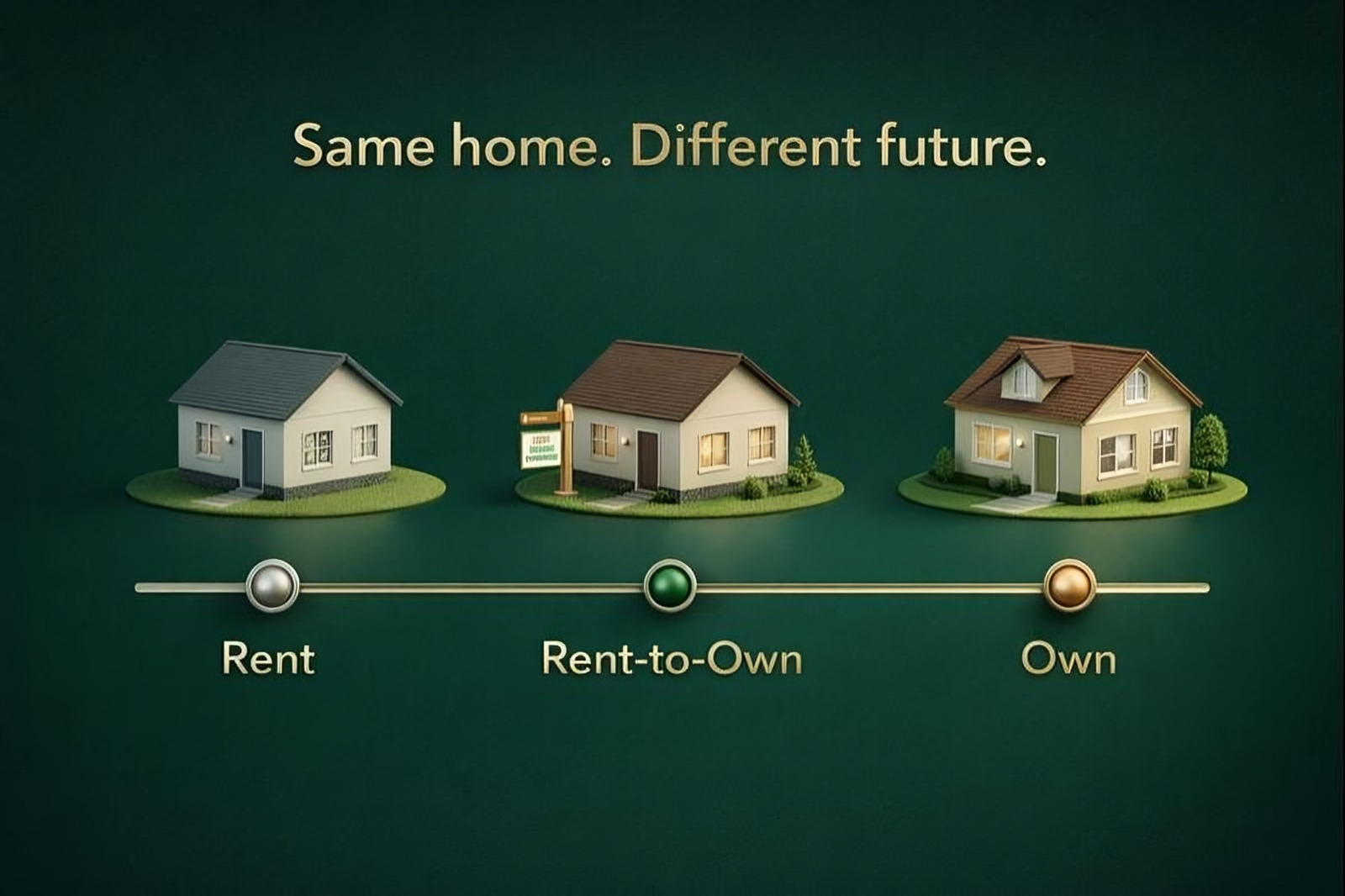
“Not all rent-to-own agreements are created equal – the structure you choose
determines who carries the risk, who controls the outcome, and how the deal ultimately ends.”
Rent-to-own (RTO) agreements were created to solve a specific market problem: many households can afford a monthly housing payments but cannot yet qualify for a traditional mortgage. These households are not looking for speculative interest and investments or luxury properties—they are seeking a stable home today and a realistic path to ownership tomorrow. To meet this need, different rent-to-own structures have evolved. Each model balances legal complexity, financial exposure, and flexibility in a different way. Some are designed to prioritize tenant protection, while others lean more heavily toward investor security.
At its core, Home Equity Partner shares the thought that rent-to-own is not a single product. It is a category of financial arrangements, and choosing the wrong one can turn a well-intentioned plan into a costly mistake for both parties. Understanding these distinctions is essential, because the structure of the agreement directly affects cash flow, legal rights, and what happens if something goes wrong.
The Three Dominant Rent-to-Own Models
Although many variations exist, nearly all rent-to-own agreements fall into one of three primary models:
- Lease Option
- Lease Purchase
- Contract for Deed
Each model exists to address different levels of commitment, legal exposure, and financial readiness. The differences may seem subtle at first glance, but they carry major consequences for how risk is distributed and how easily a deal can be exited.
Lease Option: Flexibility with Limited Obligation
The lease option model is the most common rent-to-own structure in the market today. It gives the tenant the right to purchase the home at a predetermined price within a specified time period—but not the obligation to do so.
Tenants typically pay an upfront option fee, which usually ranges from 1% to 5% of the purchase price, though some agreements cite figures as high as 10%. This fee secures the purchase option and is often credited toward the future down payment if the tenant exercises the option.
Monthly rent in a lease option arrangement is usually set above market rate, with a portion of each payment applied as a rent credit toward the purchase price. This creates a built-in savings mechanism while the tenant works on credit repair, income stability, or down payment accumulation.
From a legal standpoint, lease options are relatively simple to execute and unwind. If the tenant chooses not to buy, the agreement expires like a standard lease. This simplicity is why lease options dominate the rent-to-own market today.
Primary risk profile:
Investor risk: vacancy if the tenant walks away
Tenant risk: forfeiting the option fee and rent credits if they do not purchase
Lease Purchase: Commitment Without Immediate Ownership
Lease purchase agreements look similar to lease options on the surface, but the legal obligation is fundamentally different. In this model, the tenant is contractually required to purchase the home at the end of the lease term.
Like lease options, lease purchase agreements often involve:
- An upfront option-style fee
- Above-market rent
- Partial rent credits applied toward the purchase
The key distinction is legal enforceability. Because the tenant is obligated to buy, a failed purchase can trigger breach-of-contract disputes rather than a simple lease termination. This introduces more legal complexity and higher financial risk for both sides.
Lease purchase structures are less common in practice because they reduce flexibility and increase the likelihood of litigation if financing falls through. They are typically used only when both parties are highly confident in the tenant’s ability to qualify for a mortgage within the agreed timeline.
Primary risk profile:
Investor risk: legal disputes and delayed exit
Tenant risk: legal liability if they cannot complete the purchase
Contract for Deed: Owner Financing with Heavy Consequences
A contract for deed (also known as a land contract) is the most legally complex and highest-risk rent-to-own structure. In this model, the tenant makes principal and interest payments directly to the seller, much like a private mortgage. The contract is often recorded, and ownership is transferred only after the final payment is made.
Unlike lease-based models, contract for deed arrangements blur the line between renting and owning. The tenant assumes many of the responsibilities of ownership, including maintenance and taxes, while still lacking legal title to the property.
If the tenant defaults, the process of reclaiming the property is far more involved than a standard eviction. In many jurisdictions, it resembles a foreclosure, which can be time-consuming, expensive, and legally sensitive.
For this reason, contract for deed arrangements are heavily regulated in some states and discouraged in others. They are best reserved for highly controlled scenarios with strong legal oversight.
Primary risk profile:
Tenant risk: loss of accumulated equity upon default
Investor risk: lengthy foreclosure-style recovery process
Why Model Selection Matters
Choosing the right rent-to-own structure is not a technical detail—it is the foundation of the entire transaction. The model determines:
- How cash flow is generated
- Who bears the majority of the financial risk
- How disputes are resolved
- How easily either party can exit
- What happens if financing fails
Lease options dominate the market because they strike a practical balance between flexibility and accountability. Lease purchases increase commitment but raise legal risk. Contract for deed arrangements push risk to both sides and should only be used with full regulatory awareness.
In short, the structure you choose dictates whether rent-to-own becomes a bridge to ownership or a legal and financial liability.
What Home Equity Partner Does
At Home Equity Partner, we design rent-to-own agreements that prioritize clarity, fairness, and long-term viability. We focus primarily on the lease option model because it offers the best balance of flexibility for tenants and risk management for investors.
Each agreement is structured with:
- Realistic purchase timelines
- Transparent pricing
- Clearly defined rent credits
- Legally sound documentation
- Exit terms that avoid unnecessary disputes
We also operate selectively in markets where price-to-rent ratios are closely aligned. This ensures that above-market rent remains workable and that the future purchase price remains financially credible for the tenant.
Most importantly, Home Equity Partner treats rent-to-own as a pathway, not a pressure tactic. Our goal is not to force a sale at all costs, but to create a structured transition that gives households time to stabilize their finances while protecting investor capital.